Poultryline: Why the Right Wire Makes or Breaks Poultry Cage Performance
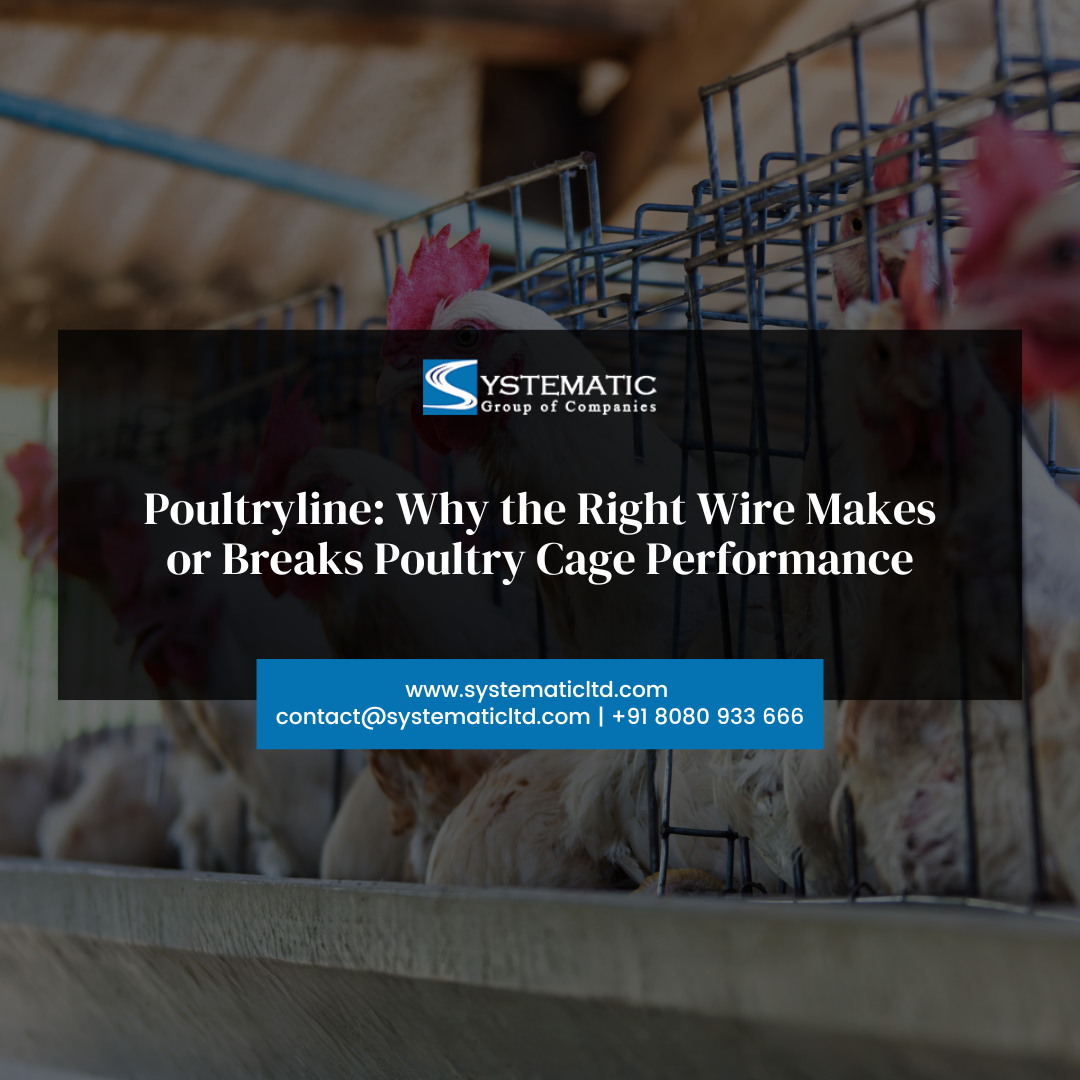
Poultryline: Why the Right Wire Makes or Breaks Poultry Cage Performance
Posted on June 06, 2026Poultry farming is one of the fastest-growing agricultural sectors in India. But the harsh reality inside a poultry shed — high humidity, ammonia from excrement, acidic conditions, and constant moisture — creates one of the most corrosive environments that any steel wire product must endure. Standard galvanized wire, adequate for fencing or construction, often fails prematurely in poultry applications, leading to cage collapse, bird injury, and costly downtime.
Poultryline is Systematic Group’s purpose-engineered wire range for the poultry industry. Every aspect of its design — from coating weight to tensile balance to weldability — addresses the specific failure modes that destroy standard wire in poultry environments.
The Poultry Corrosion Problem
Inside a poultry house, three factors combine to create a uniquely hostile environment for steel wire. First, humidity levels routinely exceed 70–80%, keeping the wire surface constantly damp. Second, ammonia from chicken excrement reacts with moisture to form ammonium hydroxide, an alkaline solution that attacks zinc coatings. Third, excrement itself is acidic, creating a dual chemical assault on the wire from both alkaline and acidic directions.
Standard galvanized wire with typical coating weights of 30–90 GSM is simply not designed for this level of chemical aggression. The zinc layer depletes rapidly, exposing the steel core to rust within 2–4 years. The result: weakened cages, safety hazards, and the expense of complete cage replacement.
How Poultryline Solves This
Heavy Galvanized Coating: 275+ GSM
The single most important specification for poultry wire is zinc coating weight. Poultryline uses a minimum of 275 GSM (grams per square metre) zinc coating — roughly 3–5 times heavier than standard GI wire. This heavy coating acts as a sacrificial layer, preventing rust and prolonging the life of the steel core far beyond what standard galvanized wire can achieve in poultry conditions.
The heavy coated zinc also provides increased strength and durability to the wire itself, making it suitable for the mechanical stresses of cage construction and years of bird contact.
Uniform Coating and Thickness
Coating consistency is as important as coating weight. A wire with an average of 275 GSM but with thin spots at 100 GSM will fail at those weak points, regardless of the overall average. Systematic Group’s hot-dip process ensures that all parts of the wire, including recesses and curves, are coated uniformly, providing comprehensive protection with no weak spots.
Smooth Surface
The zinc coating produces a smooth, even surface on the steel wire. This is important in poultry applications for two reasons: smooth wire reduces the risk of bird injury (rough or flaking wire can cut skin, increasing infection risk), and the aesthetic uniformity signals coating quality to buyers and integrators.
Balanced Tensile and Ductility
Poultry cage wire must be strong enough to hold its shape under the weight of multiple birds, but ductile enough to be bent, welded, and formed into cage structures during manufacturing. Systematic Group ensures that tensile strength and ductility are precisely balanced for the specific requirements of poultry cage construction — the wire can be formed without cracking while maintaining structural integrity once in service.
Good Weldability
Most poultry cages are constructed by welding wire into a mesh grid. Weldability is critical — the wire must form strong, clean welds without excessive spatter or coating damage. Poultryline wire is optimised for resistance welding, ensuring reliable weld joints. For operations seeking the absolute maximum weld-joint corrosion protection, Systematic Group’s Galvasys zinc-aluminium coating remains undamaged even at welded joints, eliminating the most common corrosion failure point in poultry cage mesh.
Specifications
| Parameter | Specification |
| Wire Diameter | 2 mm and above |
| Zinc Coating | 275 GSM+ (according to wire size) |
| Coating Process | Hot-dipped galvanization |
| Coating Uniformity | Full coverage including recesses and curves |
| Surface Finish | Smooth, even zinc surface |
| Weldability | Optimised for resistance welding in cage manufacturing |
The Cost Equation: Cheap Wire vs Poultryline
The upfront cost of Poultryline wire is higher than standard GI wire. But poultry cage economics are lifecycle economics. A cage made with 60 GSM standard wire that lasts 3 years costs more over a 15-year period than a cage made with 275 GSM Poultryline that lasts 10–12 years — because you build the cheap cage five times and the Poultryline cage once or twice.
Factor in the production losses during cage replacement (birds must be moved, egg production drops), labour costs for disassembly and reinstallation, and the risk of bird injury from corroded wire, and the total cost of ownership strongly favours Poultryline.
Frequently Asked Questions
What GSM coating should I use for poultry cages?
A minimum of 275 GSM is recommended for the corrosive conditions inside poultry houses. Standard coatings of 30–90 GSM are insufficient and will corrode within 2–4 years.
Can Poultryline wire be welded?
Yes. Poultryline wire is specifically optimised for resistance welding used in poultry cage manufacturing, ensuring strong, clean weld joints.
What diameter Poultryline wire should I use?
2 mm is the standard starting diameter. Larger diameters provide greater cage rigidity. The appropriate diameter depends on the cage design, bird weight, and tier configuration.
How does Poultryline compare to Galvasys for poultry?
Poultryline uses heavy zinc (275+ GSM) galvanization. Galvasys adds aluminium to the zinc for even greater corrosion resistance, especially at welded joints. For maximum cage lifespan in the most demanding poultry environments, Galvasys represents the premium upgrade over Poultryline.
Contact Systematic Group for Poultryline pricing and samples.