OPGW Cable Construction and Specifications
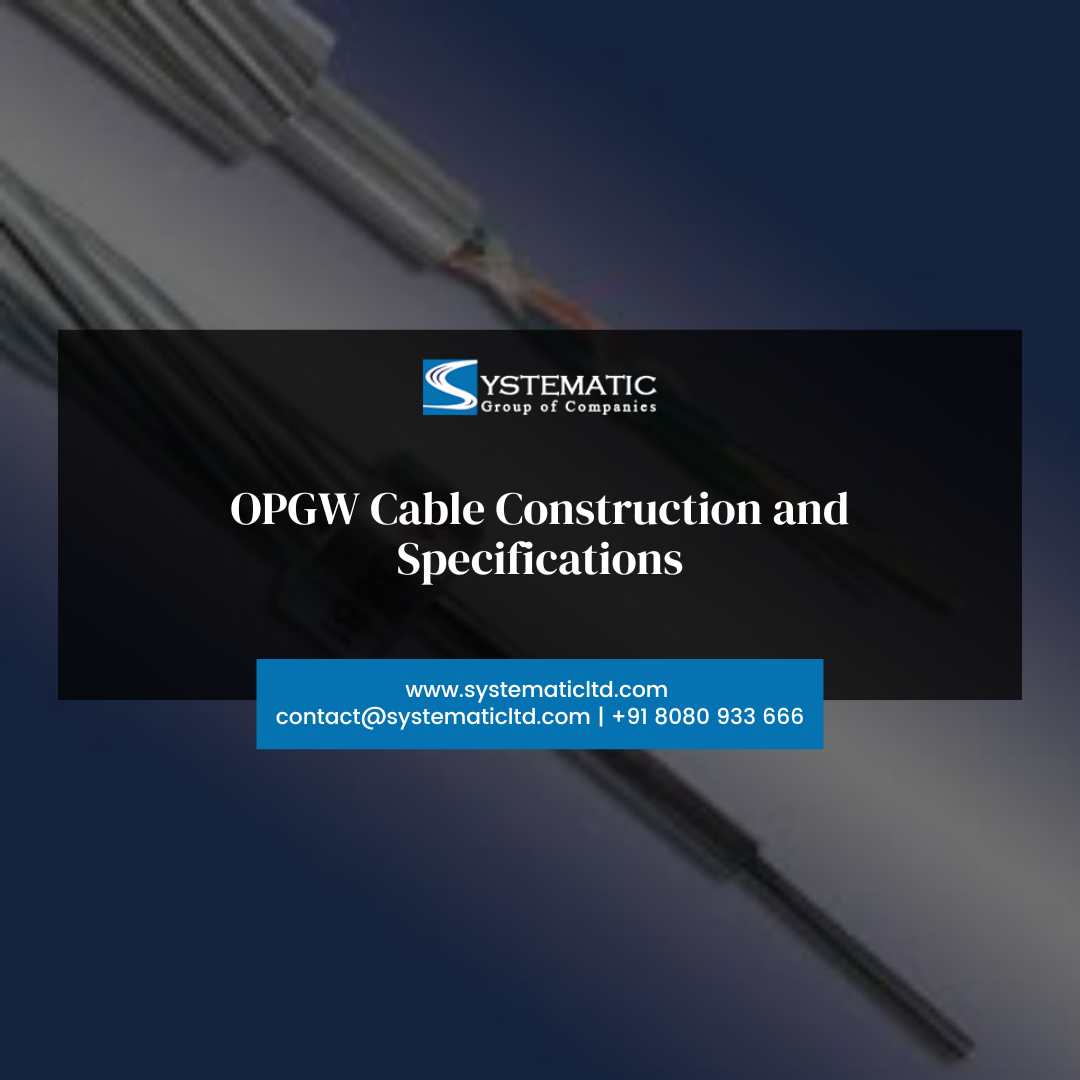
OPGW Cable Construction and Specifications
Posted on June 06, 2026OPGW (Optical Ground Wire) must do two jobs at once — carry optical fibres safely and act as the transmission line’s earth/shield wire. Its construction reflects that. This page breaks down the build and the parameters you specify when ordering Systematic’s OPGW.
Construction, layer by layer
1. Central tube — an aluminium or stainless-steel tube houses the optical fibres, protecting them from crush and moisture.
2. Stranded conductive layers — one or more layers of aluminium-clad steel (ACS) wire and aluminium-alloy or stainless-steel wires are stranded around the tube. These provide tensile strength and short-circuit current capacity.
3. Outer profile — engineered to withstand wind, ice and temperature cycling over long spans.
The choice of steel, aluminium or a combination lets the cable be tuned for strength versus current-carrying capacity. The ACS layers are the same family of wire covered in ACS wire applications.
Specifications to define
| Parameter | What it controls |
| Fibre count | Communications capacity (number of fibres in the central tube) |
| Cross-sectional area | Conductor size and weight per metre |
| Short-circuit current rating (kA²·s) | Fault current the cable can carry without damage |
| Rated tensile strength (RTS) | Maximum mechanical load / span capability |
| DC resistance | Grounding performance |
| Fibre type | G.652 / G.657 single-mode for long-haul |
Material options
• All-ACS stranding — maximum strength and corrosion life for long, high-tension spans.
• ACS + aluminium-alloy — higher short-circuit capacity where fault currents are large.
To match a construction to your line’s fault level and span, see applications and advantages of OPGW in power grids, compare against ADSS, or request OPGW specifications.
Frequently Asked Questions
What is inside an OPGW cable?
A central aluminium or stainless-steel tube holds the optical fibres, surrounded by stranded layers of aluminium-clad steel and aluminium-alloy or stainless-steel wires.
What is the short-circuit rating of OPGW?
It depends on the conductor cross-section and material mix; the rating (in kA²·s) is selected to match the line’s fault level. Systematic engineers OPGW to the project’s specified short-circuit duty.
How many fibres can OPGW carry?
Fibre count is specified per project based on communications needs; the central tube houses the required fibre count.