GI Mesh Fencing: How to Compare Types and Pick the Right Fence for Your Project

GI Mesh Fencing: How to Compare Types and Pick the Right Fence for Your Project
Posted on March 03, 2026Not all GI mesh fencing is created equal. A welded mesh panel that secures a warehouse perimeter has almost nothing in common with a hexagonal mesh protecting a poultry farm, even though both carry the same galvanized iron label. Choosing the wrong type means overspending, under-protecting, or replacing the fence within a few years.
This guide breaks down every major type of GI mesh fencing available in India, compares them head-to-head on strength, cost, and best-fit applications, and gives you a decision framework so you can match the right fence to your exact requirement. All specifications referenced here are drawn from Systematic Ltd’s product range, one of India’s leading galvanized wire manufacturers with manufacturing capacity exceeding 100,000 MT annually.
What Makes GI Mesh Fencing Different from Other Fencing Materials?
Before comparing types, it helps to understand what separates GI mesh fencing from alternatives like plain steel, wooden, or concrete fencing. The “GI” stands for galvanized iron — meaning the steel wire is coated with zinc through a hot-dip galvanization process. This zinc layer does three things that other materials cannot do simultaneously:
- Self-healing corrosion barrier: When scratched, the surrounding zinc sacrificially corrodes to protect the exposed steel, extending the wire’s life to 50–60 years according to Systematic Ltd’s technical data.
- Consistent mechanical strength: GI wire maintains tensile strength between 300–900 N/mm² depending on the gauge, far exceeding wooden or polymer alternatives.
- Visibility with security: Unlike solid walls or wooden fences, mesh structures allow airflow, natural light, and visual surveillance while still acting as a physical barrier.
The base wire used in quality GI mesh fencing conforms to standards like IS 280, BS 443, and ASTM A641. Systematic’s GI wires are available in diameters from 0.90 mm to 6.00 mm with zinc coatings ranging from 30–366 GSM. The wire diameter, zinc coating weight, and mesh pattern together determine which type of fence you should choose.
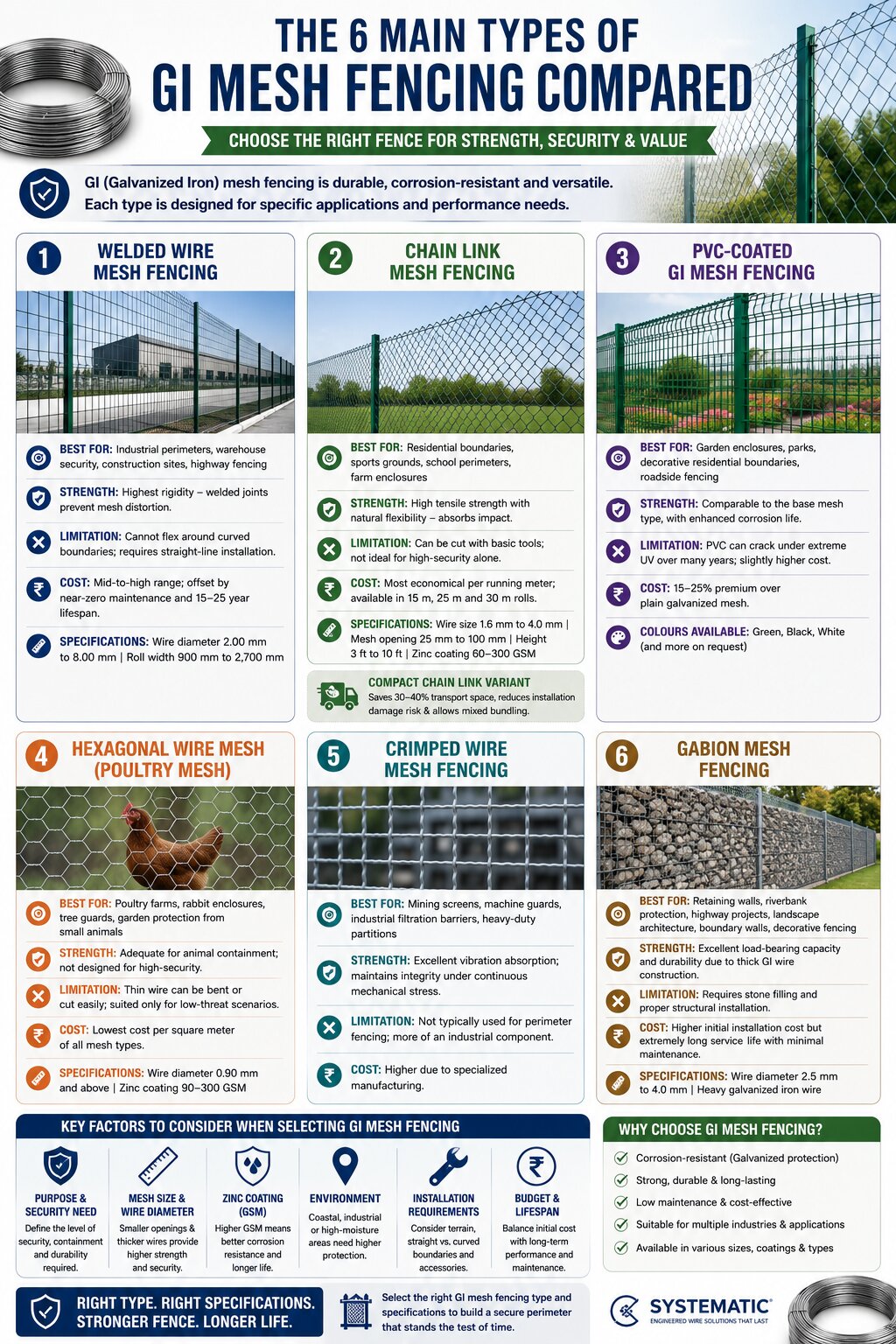
The 6 Main Types of GI Mesh Fencing Compared
1. Welded Wire Mesh Fencing
Welded mesh is made by taking two sets of orthogonal steel wires and resistance-welding them at every intersection. This creates a rigid grid that cannot be pulled apart or deformed without cutting. Systematic’s welded wire mesh is manufactured with wire diameters from 2.00 mm to 8.00 mm and roll widths from 900 mm (3 feet) up to 2,700 mm (9 feet).
- Best for: Industrial perimeters, warehouse security, construction site barriers, highway fencing
- Strength: Highest rigidity of all mesh types — the welded joints prevent mesh distortion
- Limitation: Cannot flex around curved boundaries; requires straight-line installation
- Cost: Mid-to-high range; offset by near-zero maintenance and 15–25 year lifespan
2. Chain Link Mesh Fencing
Chain link is woven (not welded) from GI wire into interlocking diamond-shaped openings. It is the most widely used fencing type in India due to its adaptability. Systematic’s chain link fence uses hot-dipped galvanized wire per IS 280, available in wire sizes from 1.6 mm to 4.0 mm, mesh openings from 25 mm to 100 mm, heights from 3 feet to 10 feet, and zinc coating from 60–300 GSM.
- Best for: Residential boundaries, sports grounds, school perimeters, farm enclosures
- Strength: High tensile strength with natural flexibility — absorbs impact from wind, animals, and accidental contact
- Limitation: Can be cut with basic tools; not ideal for high-security requirements alone
- Cost: Most economical per running meter; available in 15 m, 25 m, and 30 m rolls
Systematic also manufactures a compact chain link fence variant that saves 30–40% transport space, reduces installation damage risk, and allows mixed bundling for logistics efficiency.
3. PVC-Coated GI Mesh Fencing
This is essentially welded or chain link mesh with an additional PVC powder coating over the galvanized wire. The PVC layer adds a second barrier against corrosion and is available in multiple colours (green, black, white). It is the preferred choice when the fence must serve a decorative function alongside security.
- Best for: Garden enclosures, parks, decorative residential boundaries, roadside fencing
- Strength: Comparable to the base mesh type, with enhanced corrosion life in coastal or chemical-exposure environments
- Limitation: PVC can crack under extreme UV over many years; slightly higher cost
- Cost: 15–25% premium over plain galvanized mesh
4. Hexagonal Wire Mesh (Poultry Mesh)
Hexagonal mesh uses thinner GI wire (typically 0.90 mm and above) woven into hexagonal openings. It is specifically designed for lightweight containment. Systematic’s GI wire for poultry cage and mesh applications uses wire with 90–300 GSM zinc coating, ensuring long outdoor life even in high-moisture poultry environments.
- Best for: Poultry farms, rabbit enclosures, tree guards, garden protection from small animals
- Strength: Adequate for animal containment; not designed for high-security applications
- Limitation: Thin wire can be bent or cut easily; suited only for low-threat scenarios
- Cost: Lowest cost per square meter of all mesh types
5. Crimped Wire Mesh Fencing
Crimped mesh uses pre-bent (crimped) wires interlocked at each crossing point, creating a strong screen without welding. This type is primarily used in heavy industrial settings where vibration resistance and screening are needed.
- Best for: Mining screens, machine guards, industrial filtration barriers, heavy-duty partitions
- Strength: Excellent vibration absorption; maintains integrity under continuous mechanical stress
- Limitation: Not typically used for perimeter fencing; more of an industrial component
- Cost: Higher due to specialized manufacturing
6. Gabion Mesh Fencing
Gabion mesh is manufactured using heavy galvanized iron wire and is commonly used for stone-filled retaining structures, erosion control, architectural fencing, and landscape applications. Systematic’s gabion mesh is available in wire diameters ranging from 2.5 mm to 4.0 mm, offering high structural strength and long-term corrosion resistance in outdoor environments.
- Best for: Retaining walls, riverbank protection, highway projects, landscape architecture, boundary walls, and decorative fencing
- Strength: Excellent load-bearing capacity and durability due to thick GI wire construction
- Limitation: Requires stone filling and proper structural installation
- Cost: Higher initial installation cost but extremely long service life with minimal maintenance
Gabion mesh is especially preferred in infrastructure and civil engineering projects where both reinforcement and drainage are required simultaneously. The galvanized coating protects the wire from rust, while the stone-filled structure absorbs pressure and prevents soil erosion effectively.
Decision Framework: Matching Fence Type to Project Requirements
Rather than choosing based on price alone, evaluate your project against these five criteria:
- Security level: High security (warehouse, factory) → welded mesh or welded + barbed wire combination. Standard security (farm, residence) → chain link. Low security (garden, tree guard) → hexagonal mesh.
- Environment: Coastal, humid, or chemical-exposure zones → PVC-coated mesh or heavy zinc coating (275+ GSM). Dry inland → standard galvanized (60–120 GSM) is sufficient.
- Terrain: Curved or undulating land → chain link (flexible). Flat, straight boundaries → welded mesh panels.
- Budget: Hexagonal mesh is cheapest per m² but limited in strength. Chain link offers the best value for general fencing. Welded mesh costs more upfront but lasts longest.
- Aesthetics: PVC-coated mesh for visual appeal. Standard galvanized if appearance is not a concern.
Zinc Coating: The Factor Most Buyers Overlook
The zinc coating weight (measured in GSM — grams per square metre) is arguably the single most important specification in GI mesh fencing. Systematic Ltd offers coatings from 30 GSM up to 366 GSM. Here’s a practical breakdown:
- 30–60 GSM: Indoor use, temporary barriers, protected environments
- 60–120 GSM: Standard outdoor fencing in dry climates
- 120–275 GSM: Agricultural fencing, outdoor permanent installations
- 275–366 GSM: Coastal environments, chemical plants, maximum longevity requirements
Higher GSM means more zinc, which translates directly to longer corrosion-free life. Hot-dip galvanized wire, as manufactured by Systematic, deposits zinc uniformly across all surfaces including the hollow sections of the wire cross-section, offering superior protection compared to electrogalvanized alternatives. For a detailed comparison, see Systematic’s guide on galvanized wire vs stainless steel wire.
Common Mistakes When Buying GI Mesh Fencing
Based on industry experience, these are the errors that lead to premature fence failure or wasted spend:
- Choosing by price alone: A 60 GSM chain link fence at a coastal site will corrode in 3–5 years. Spending 20% more for 275 GSM coating extends life to 15–20+ years.
- Wrong mesh opening size: A 100 mm opening won’t keep out small animals or children. For animal containment, stay below 50 mm.
- Ignoring post and support quality: Even the best mesh fails if the posts are inadequate. Chain link fencing needs tension wire to stay stable; welded mesh panels need properly anchored columns.
- Skipping the scrape test: A simple scrape test reveals whether the wire is genuinely hot-dip galvanized or merely painted with zinc-rich paint (cold galvanizing), which offers far inferior protection.
Why Systematic Ltd for GI Mesh Fencing?
Systematic Group, established in 2000, operates multiple hi-tech manufacturing units near Mumbai with an annual capacity exceeding 100,000 MT. The company holds BIS certification and conforms to IS, BS, DIN, JIS, and ASTM specifications. Key differentiators include:
- In-house R&D cell for continuous wire quality improvement
- Wire diameters from 0.90 mm to 6.00 mm covering every fencing application
- Zinc coatings from 30–366 GSM for all environment types
- Pan-India distribution with export presence in Southeast Asia, Africa, Europe, and the Middle East
- Custom manufacturing capability for non-standard specifications
Whether you need welded wire mesh for construction, chain link fencing for farms, or barbed wire for high-security perimeters, Systematic’s product range covers every GI mesh fencing requirement from a single, certified source.
Depending upon the specific fencing or caging application, both woven and welded wire mesh can be configured to achieve the desired opening size. This versatility makes them ideal for Wire Fencing solutions, allowing users to choose the right mesh design based on security, animal containment, and property protection requirements.
Frequently Asked Questions
What is the lifespan of GI mesh fencing?
With proper zinc coating (120+ GSM) and standard outdoor conditions, GI mesh fencing lasts 15–25 years. Heavy coating (275+ GSM) can extend life to 50+ years in non-corrosive environments.
Which mesh size is best for farm fencing?
For general farm boundary fencing, 50 mm–100 mm mesh openings work well. For poultry or small animal containment, choose 25 mm–50 mm openings with hexagonal or welded mesh.
Can GI mesh fencing be used for construction sites?
Yes. Welded wire mesh panels are the standard for construction site perimeters. They provide rigid, tamper-resistant barriers. Systematic’s welded wire mesh in 2–8 mm wire diameter is widely used in Indian infrastructure projects.
What is the difference between welded mesh and chain link fencing?
Welded mesh has wires fused at every intersection, making it rigid and cut-resistant. Chain link is woven (not welded), making it flexible and impact-absorbent. Welded mesh suits high-security applications; chain link suits general-purpose fencing. Read the detailed comparison in the welded wire mesh fencing guide.
How do I verify if a GI fence is truly hot-dip galvanized?
Perform a scrape test: scrape the wire surface with a hard object. Genuine hot-dip galvanized wire shows a matte grey zinc layer underneath. Cold-galvanized (painted) wire shows bare steel. Systematic’s GI wire quality guide explains how to identify premium galvanization.