GI Wire Mesh Applications: How Galvanized Wire Mesh Is Used Across Construction, Industry
GI Wire Mesh Applications: How Galvanized Wire Mesh Is Used Across Construction, Industry
Posted on March 03, 2026GI wire mesh appears in more places than most people realize. The reinforcement inside a plastered wall, the screen guarding a factory machine, the cage housing poultry birds, the gabion retaining a hillside highway – all of these use galvanized iron wire mesh in some form. What makes GI wire mesh this versatile is its combination of structural rigidity, corrosion resistance, and cost-efficiency that no other single material matches.
This article maps out every major application of GI wire mesh across industries, with the specific mesh types, sizes, and specifications used in each. All technical data is referenced from Systematic Ltd’s product catalogue and knowledge base – India’s leading wire mesh manufacturer with the latest welded mesh production machinery and certified quality systems.
What Exactly Is GI Wire Mesh?
GI wire mesh is a grid structure made from galvanized steel wires – either welded or woven at their intersections. The “GI” refers to the galvanization process where the base steel wire is coated with zinc (typically via hot-dip galvanization) to prevent rust and corrosion.
The mesh has square or rectangular open spaces that provide a balance between structural strength and material/weight efficiency. Unlike solid steel sheets, wire mesh allows airflow, visibility, and drainage while maintaining physical barrier properties.
Technical parameters that define a GI wire mesh product:
- Wire diameter: Ranges from 2.00 mm to 8.00 mm in Systematic’s manufacturing range
- Mesh opening (section of roll): From 25 mm to 200 mm, defining the gap between wires
- Roll width: 900 mm (3 feet) to 2,700 mm (9 feet)
- Raw material grades: Mild steel wire, galvanized wire, stainless steel wire, high-carbon wire
- Standards: IS 1566, IS 432 (Part II)/1982/2002, BS 4482/1969, BS 4483/1969
The galvanization can happen before or after the welding process. Galvanized-before-woven (GBW) is the standard approach and more cost-effective. Galvanized-after-woven (GAW) provides zinc coverage even on the weld joints but costs more. For most fencing and construction applications, GBW wire mesh from Systematic delivers adequate protection.
Application 1: Construction Reinforcement
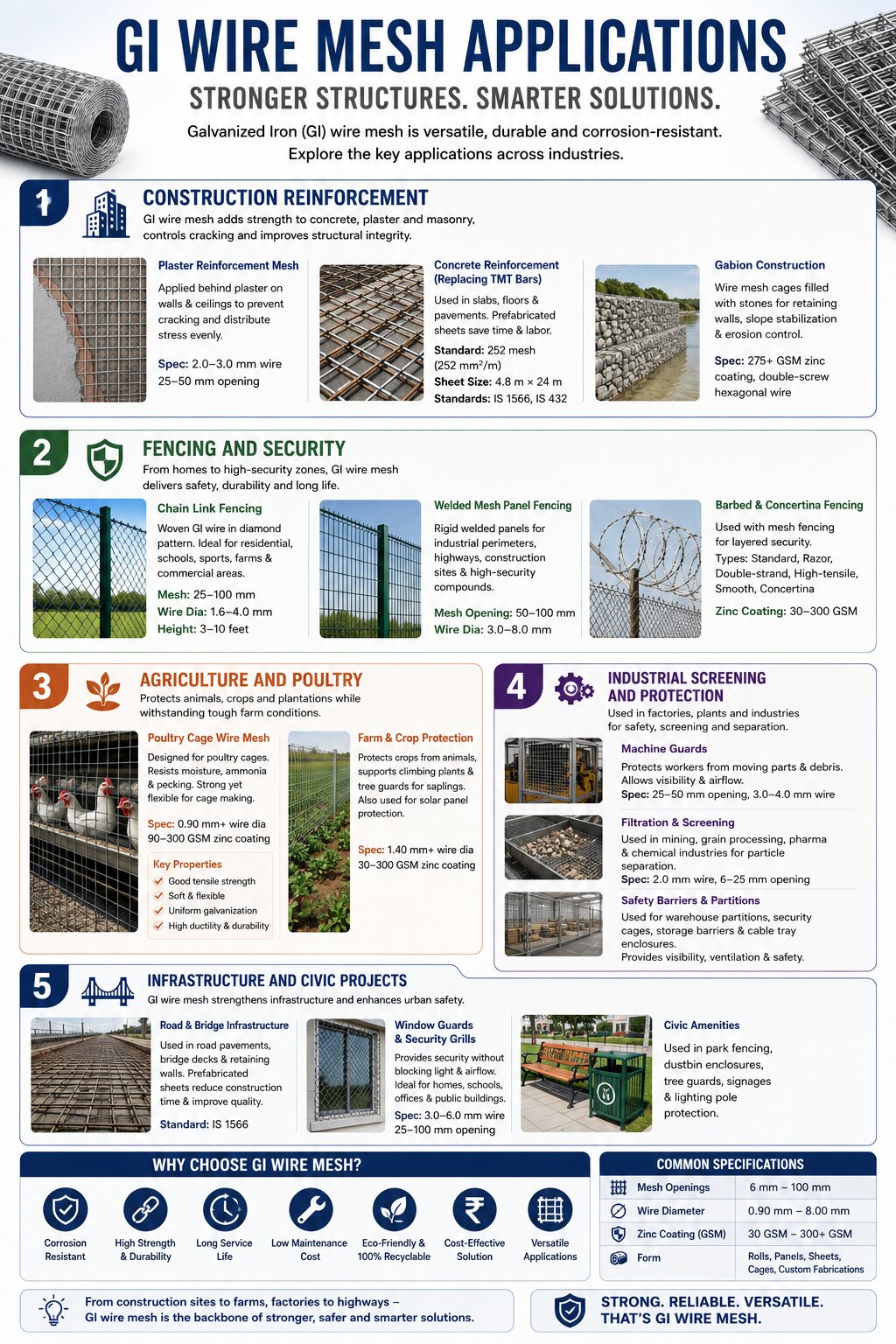
Construction is the largest consumer of GI wire mesh in India. The mesh serves as a reinforcement material inside concrete, plaster, and masonry to increase tensile strength and control cracking.
Plaster Reinforcement Mesh
Applied behind plaster on walls and ceilings to prevent cracking, especially at joints between different materials (brick to concrete, old wall to new extension). The mesh distributes stress across a wider area, preventing localized crack formation. Typical specification: 2.0–3.0 mm wire diameter, 25–50 mm mesh opening.
Concrete Reinforcement (Replacing TMT Bars)
Welded wire mesh is increasingly used as a replacement for TMT (Thermo Mechanically Treated) bars in slab reinforcement, particularly in floors and road pavements. The mesh comes as prefabricated sheets, eliminating the labor-intensive process of manually tying individual bars. Systematic’s welded wire mesh for reinforcement follows IS 1566 and IS 432 standards. The standard reinforcement mesh designation “252 mesh” refers to a square mesh with 252 mm²/m longitudinal wire area, supplied in 4.8 m × 24 m fabric sheets.
Gabion Construction
Gabion baskets – wire mesh cages filled with stones – are fundamental in civil engineering for retaining walls, slope stabilization, and erosion control. The wire mesh must withstand permanent contact with soil, water, and stone abrasion. Systematic’s wire for gabions uses heavy zinc coating (275+ GSM) and is made from double-screw hexagonally twisted steel wires for maximum structural integrity. Gabion baskets, gabion mattresses (reno mattresses), and sack gabions each use different mesh configurations. For a complete overview, see the gabion wire guide.
Application 2: Fencing and Security
Fencing is the most visible application of GI wire mesh, spanning residential, commercial, agricultural, and industrial contexts.
Chain Link Fencing
Chain link fencing uses woven (not welded) GI wire mesh in a diamond pattern. Available in mesh sizes from 25–100 mm, wire sizes from 1.6–4.0 mm, and heights from 3–10 feet. It’s the most popular fencing solution in India for residential boundaries, school perimeters, sports facilities, and farm enclosures. For installation guidance, see the ultimate chain link fencing guide.
Welded Mesh Panel Fencing
Rigid panels made from welded GI wire mesh offer higher security than chain link because the welded joints cannot be pulled apart. Used for industrial perimeters, construction site barriers, highway dividers, and high-security compounds. Mesh openings of 50–100 mm with 3.0–8.0 mm wire diameter are standard for security applications.
Barbed Wire and Concertina Fencing
While technically wire products rather than mesh, barbed and concertina wires are frequently combined with GI mesh fencing for layered security. Systematic’s barbed wire range includes standard, razor, double-strand, high-tensile, smooth, and concertina types – all made from galvanized wire with 30–300 GSM coating. For detailed type descriptions, refer to the top 10 reasons to use fencing wire.
Application 3: Agriculture and Poultry
Poultry Cage Wire Mesh
Poultry farming is one of the most demanding applications for GI wire mesh because the wire must resist continuous exposure to moisture, ammonia from bird waste, and physical pecking. Systematic’s poultry cage wire uses GI wire with 90–300 GSM zinc coating in diameters of 0.90 mm and above. The wire must have both welding quality (for cage fabrication) and adequate softness (for bending without cracking).
Properties of good quality poultry cage wire from Systematic Ltd:
- Good tensile strength for structural rigidity
- Soft and flexible for cage forming
- Precise galvanization with uniform zinc coating
- High ductility and durability for long service life
Farm and Crop Protection
GI wire mesh is used to create enclosures protecting crops from animals, support structures for climbing plants (grapes, tomatoes, kiwis), and tree guards protecting saplings. The wire for farming applications is available in diameters from 1.40 mm and above with 30–300 GSM zinc coating. Solar panel protection using fencing wire has also become a growing application as solar installations expand across Indian farmland.
Application 4: Industrial Screening and Protection
Machine Guards
Factory machinery requires physical guarding to protect workers from moving parts, flying debris, and pinch points. GI wire mesh guards offer visibility (operators can monitor machine operation), airflow (preventing heat buildup), and strength (stopping accidental contact). Welded mesh with 25–50 mm openings and 3.0–4.0 mm wire diameter is standard for this purpose.
Filtration and Screening
Woven GI wire mesh serves as screening material in mining, grain processing, pharmaceutical manufacturing, and chemical industries. The uniform mesh structure allows precise particle size separation. Finer meshes (2.0 mm wire, 6–25 mm openings) are used for grain powder filtration, while coarser meshes handle aggregate screening in mining and construction.
Safety Barriers and Partitions
Warehouse and factory partitions, security cages for valuable equipment, storage compound barriers, and cable tray enclosures all use GI wire mesh panels. The mesh provides physical separation while allowing visibility, ventilation, and fire sprinkler access.
Application 5: Infrastructure and Civic Projects
Road and Bridge Infrastructure
Welded wire mesh is used in road pavement reinforcement, bridge deck overlays, and retaining wall construction. The prefabricated mesh sheets significantly reduce construction time compared to manual rebar tying. Systematic’s infrastructure-grade mesh follows IS 1566 for reinforcement specifications.
Window Guards and Security Grilles
Residential and commercial buildings use GI wire mesh for window guards, balcony railings (as child safety mesh), ventilation grilles, and foundation ventilation screens. The galvanized coating ensures the mesh maintains appearance and function for decades without rust staining.
Cable Trays and Electrical Infrastructure
Wire mesh cable trays offer superior ventilation for cable cooling compared to solid metal trays. They are lighter, more economical, and allow easy cable routing changes. GI wire mesh cable trays are used in commercial buildings, data centres, and industrial plants.
Choosing the Right GI Wire Mesh: Specification Matrix
Match your application to the right mesh specification:
| Application | Wire Dia. (mm) | Mesh Opening | Zinc (GSM) | Mesh Type |
| Concrete reinforcement | 4.0–8.0 | 100–200 mm | 60–120 | Welded |
| Plaster reinforcement | 2.0–3.0 | 25–50 mm | 60–120 | Welded |
| Gabion baskets | 2.5–4.0 | 60–100 mm | 275+ | Hexagonal |
| Chain link fencing | 1.6–4.0 | 25–100 mm | 60–300 | Woven |
| Security panels | 3.0–8.0 | 50–100 mm | 120+ | Welded |
| Poultry cages | 0.90–1.60 | 12–25 mm | 90–300 | Welded/Woven |
| Machine guards | 3.0–4.0 | 25–50 mm | 60–120 | Welded |
| Industrial screening | 2.0–4.0 | 6–25 mm | 60–120 | Woven |
| Cable trays | 3.0–5.0 | 50–100 mm | 60–120 | Welded |
| Farm/crop protection | 1.4–2.5 | 25–75 mm | 30–300 | Welded/Woven |
GI Wire Mesh vs. Alternatives: When Is It the Right Choice?
GI wire mesh competes with several materials depending on the application:
- GI wire mesh vs. stainless steel mesh: Stainless steel offers superior corrosion resistance but costs 3–5x more. GI mesh with heavy zinc coating (275+ GSM) provides 80% of the corrosion life at a fraction of the cost. For a detailed comparison, see Systematic’s GI wire vs stainless steel wire analysis.
- GI wire mesh vs. plastic/polymer mesh: Plastic mesh costs less initially but has poor tensile strength, UV degradation, and cannot be used for structural reinforcement. GI mesh is the only option where load-bearing is required.
- GI wire mesh vs. TMT bars: For slab reinforcement, prefabricated wire mesh sheets reduce installation labor by 50–70% compared to manual bar tying. The mesh also provides more uniform reinforcement distribution.
- GI wire mesh vs. wooden fencing: Wood rots, termites attack it, and it requires regular treatment. GI mesh is maintenance-free and lasts 3–5x longer.
About Systematic Ltd: India’s Wire Mesh Manufacturing Leader
Systematic Group has been at the forefront of wire mesh manufacturing since 2000. The company operates the latest welded mesh production machinery and is a certified wire mesh manufacturer continuously supplying mesh to marquee infrastructure projects across India.
Key manufacturing capabilities:
- Wire drawing: High-speed drawing capacity with hi-tech global and local machines
- Hot-dip galvanizing: Wires passed through molten zinc bath with jumbo coil weight of 1 MT
- Welded mesh production: Advanced resistance welding with precision cross-wire placement
- Quality testing: Coating thickness, wire diameter accuracy, mesh uniformity, and tensile strength verification
- Packaging: Stretch film plastic wrapping for rolls; stretch film on wooden pallets for sheets
Beyond wire mesh, Systematic’s product range extends to binding wire, stay wire, spring steel wire, cable armour wire, and optical fiber cables (OFC) – making it a single-source supplier for both wire products and infrastructure communication solutions.
Frequently Asked Questions
What is the difference between welded and woven GI wire mesh?
Welded mesh has wires resistance-welded at every intersection, creating a rigid grid that maintains its shape. Woven mesh has wires interlocked by weaving over and under each other, creating a flexible fabric. Welded mesh is used for structural reinforcement and rigid barriers; woven mesh is used for flexible fencing and filtration.
What does ‘252 mesh’ mean?
252 mesh refers to a reinforced square wire mesh with 252 mm²/m longitudinal wire area, supplied in standard 4.8 m × 24 m welded fabric sheets. It is a standardized designation for concrete reinforcement mesh per IS 1566.
Can GI wire mesh be customized?
Yes. Systematic Ltd offers custom manufacturing for non-standard wire diameters, mesh openings, roll widths, zinc coating weights, and raw material grades. Contact Systematic to discuss specific requirements.
Is GI wire mesh the same as wire jali?
“Wire jali” is the Hindi term for wire mesh (jali = mesh/net). GI wire jali and GI wire mesh refer to the same product – galvanized iron wire welded or woven into a grid pattern. Systematic supplies wire jali across India from its multiple distribution centres.
How is GI wire mesh packaged for delivery?
Rolls are wrapped in stretch film plastic wrapping. Flat sheets are wrapped in stretch film and mounted on wooden pallets for safe transport. Systematic’s compact packaging saves 30–40% transport space compared to standard packaging.