GI Fencing Wire Specifications: A Technical Guide to Wire Gauge, Zinc Coating, and Selection

GI Fencing Wire Specifications: A Technical Guide to Wire Gauge, Zinc Coating, and Selection
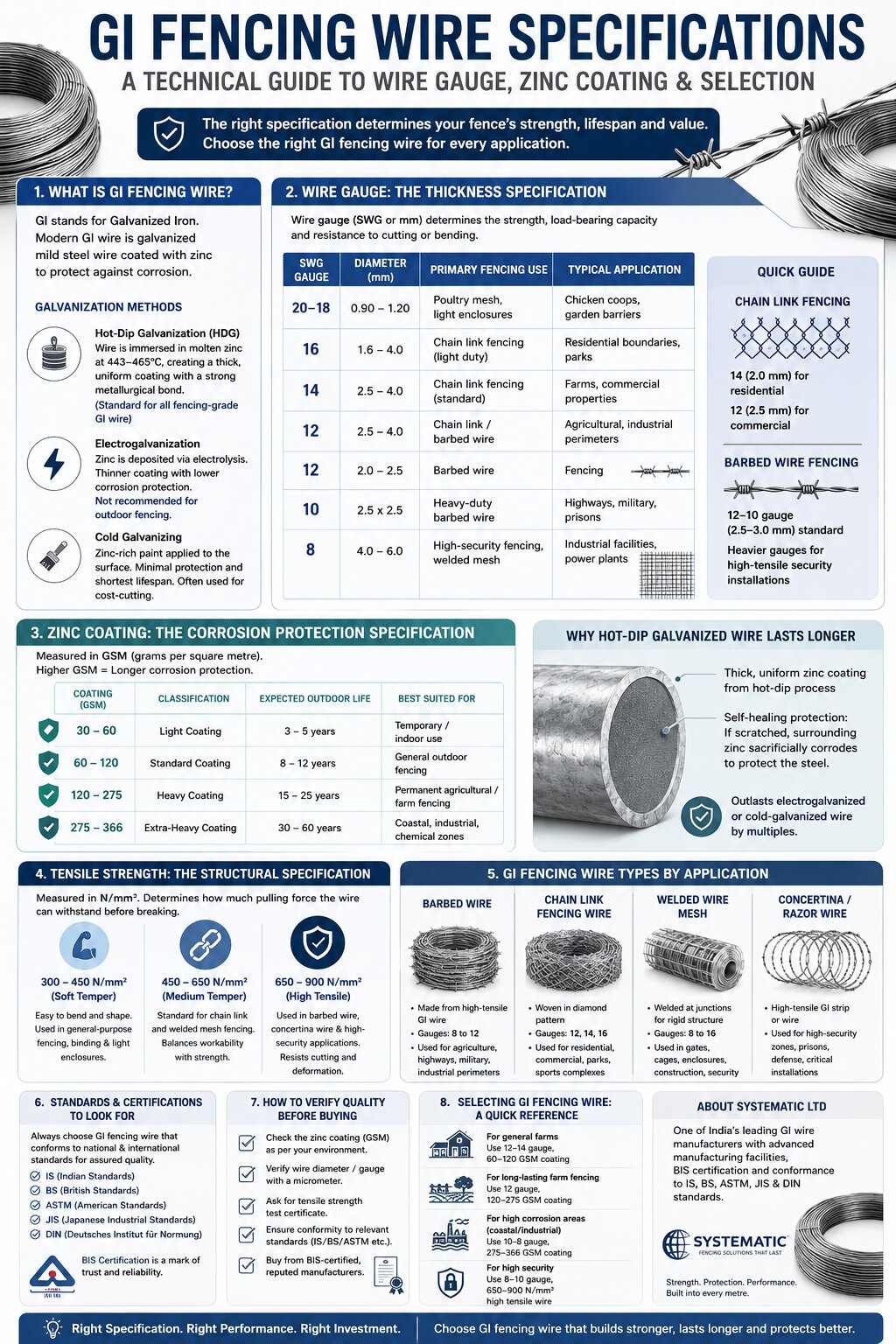
Posted on March 03, 2026GI fencing wire is hot-dip galvanized mild steel wire supplied in 0.90 – 6.00 mm diameters (SWG 20 – 8), with 30 – 366 GSM zinc coating and 300 – 900 N/mm² tensile strength, per IS 280 (1978).
When a procurement manager orders “GI fencing wire,” they might receive anything from a 16-gauge chain link wire with 60 GSM coating to an 8-gauge barbed wire strand with 300 GSM heavy zinc. The difference between these two products is massive – in cost, in lifespan, and in what they can actually fence.
This technical guide decodes every specification that matters when selecting GI fencing wire: wire gauge, zinc coating weight, tensile strength, and application-specific standards. All specifications are referenced from Systematic Ltd’s manufacturing data – one of India’s leading GI wire manufacturers, with BIS certification and conformance to IS, BS, ASTM, JIS, and DIN standards.
If you only need the numbers, the fencing wire gauge, GSM and size chart is the quick-lookup version of this page.
The master specification range
Every product below is drawn from the same base wire. These are the outer limits of Systematic’s hot-dip galvanized wire range:
|
Parameter |
Range |
|
Diameter |
0.90 mm to 6.00 mm |
|
Grade |
Mild steel |
|
Zinc coating |
30 to 366 GSM (low / medium / heavy) |
|
Tensile strength |
300 to 900 N/mm² |
|
Galvanization method |
Hot-dip (molten zinc bath) |
|
Core standard |
IS 280 (1978) |
Individual products occupy narrower windows inside that range – a chain link wire and a gabion wire are not interchangeable even though both are “GI fencing wire.” The per-application tables further down give the actual working specification for each.
Understanding GI fencing wire: what “GI” actually means
GI stands for Galvanized Iron. The term is technically a misnomer – modern “GI wire” is galvanized mild steel wire, not iron. The wire starts as a mild steel rod, is drawn to the required diameter, and is then coated with zinc through one of three galvanization methods:
- Hot-dip galvanization (HDG) – the wire is immersed in a molten zinc bath, creating a metallurgical bond between zinc and steel and depositing a thick, uniform coating across all surfaces. This is the standard for all fencing-grade GI wire, and the method Systematic uses exclusively for fencing wire.
- Electrogalvanization – zinc is deposited via electrolysis, producing a thinner, shinier coating with lower corrosion protection. Not recommended for outdoor fencing.
- Cold galvanizing – essentially zinc-rich paint applied to the wire surface. Minimal protection and the shortest lifespan. Often used for cost-cutting by lower-tier manufacturers.
For a detailed comparison of these methods, see how GI wire is made, which covers the full manufacturing process including flux preparation, zinc bath chemistry, and coating adhesion testing, or why hot-dip galvanization is best for steel wires.
Wire gauge: the thickness specification
Wire gauge — measured in SWG (Standard Wire Gauge) or mm diameter – directly determines load-bearing capacity and resistance to cutting or bending. Thicker wire means a stronger fence, but also a heavier and more expensive one.
Systematic’s chain link production uses the following gauge-to-diameter mapping, which is the reference point for fencing wire generally:
|
SWG gauge |
Diameter |
Typical fencing use |
|
20–18 |
0.90–1.20 mm |
Poultry mesh, light enclosures, garden barriers |
|
16 |
1.6 mm |
Chain link, light duty – residential boundaries, parks |
|
14 |
2.0 mm |
Chain link, standard – farms, commercial properties |
|
12 |
2.5 mm |
Chain link and barbed wire – agricultural, industrial perimeters |
|
10 |
3.0 mm |
Heavy-duty barbed wire – highways, security installations |
|
8 |
4.0 mm |
High-security fencing, welded mesh – industrial facilities |
For chain link fencing, the most common gauges are 14 (2.0 mm) for residential and 12 (2.5 mm) for commercial use. For barbed wire, 12–10 gauge (2.5–3.0 mm) is standard, with heavier gauges reserved for high-tensile security installations. Welded mesh panels use base wire up to 8.00 mm.
See also: Ultimate Chain Link Fence Wire FAQs
Zinc coating: the corrosion protection specification
Zinc coating is measured in GSM (grams per square metre) and is the primary determinant of how long the wire resists corrosion before the base steel is exposed. Systematic offers GI wire with coatings from 30 to 366 GSM.
|
Coating (GSM) |
Classification |
Expected outdoor life |
Best suited for |
|
30–60 |
Light |
3–5 years |
Temporary or indoor use |
|
60–120 |
Standard |
8–12 years |
General outdoor fencing |
|
120–275 |
Heavy |
15–25 years |
Permanent agricultural / farm fencing |
|
275–366 |
Extra-heavy |
30–60 years |
Coastal, industrial, chemical zones |
The hot-dip process creates a coating with a self-healing property: if the zinc surface is scratched, the surrounding zinc sacrificially corrodes to protect the exposed steel. This is why hot-dip galvanized wire outlasts electrogalvanized or cold-galvanized alternatives by multiples. For a comparison against a different corrosion strategy, see galvanized wire vs stainless steel wire.
Note that coating range varies by product. Chain link wire is supplied at 60–300 GSM; agricultural, barbed and welded-mesh fencing wire at 30–300 GSM; poultry wire at 90–300 GSM; gabion wire at 220–300 GSM. The full 30–366 GSM window applies to the hot-dip galvanized wire range as a whole, not to any single fencing product.
See also: Hot Dipped Galvanized Wires FAQs
Tensile strength: the structural specification
Tensile strength – measured in N/mm² or kgf/mm² – determines how much pulling force the wire withstands before breaking. For fencing this matters because fences sit under constant tension from wind load, animal impact, and thermal expansion. Systematic’s GI wire is available from 300 to 900 N/mm².
- 300–450 N/mm² (soft temper) – easy to bend and shape. Used in general-purpose fencing, binding, and light enclosures.
- 450–650 N/mm² (medium temper) – standard for chain link and welded mesh fencing. Balances workability with strength.
- 650–900 N/mm² (high tensile) – used in barbed wire, concertina wire, and high-security applications. Resists cutting and deformation, and holds tension through temperature fluctuation.
Gabion wire is a deliberate exception: it is supplied at 350–500 N/mm² because gabion baskets need flexibility to conform to ground movement rather than maximum tensile resistance.
For fencing wire used in welded wire mesh, specify wire with both welding quality and tensile strength retained after welding – resistance welding can locally reduce wire strength at junction points.
GI fencing wire types by application
Each product below carries its own working specification. These are the numbers to quote on a purchase order.
Barbed wire and general fencing wire
Made from two twisted GI wires with sharp barbs at regular intervals. Available in standard, double-strand, high-tensile, concertina, and PVC-coated variants. Used for property boundary marking, animal containment, and security.
|
Parameter |
Specification |
|
Diameter |
2.00–4.00 mm |
|
Zinc coating |
30–300 GSM |
|
Standards |
IS 280 (1978), BS 10223 Part 3 |
Full detail in the barbed wire guide and on the wire for agriculture and fencing product page.
Chain link fencing wire
Woven into diamond-shaped interlocking patterns from single GI wire strands. Heavier gauges (10–8) suit commercial and industrial fencing; 14-gauge suits household use.
|
Parameter |
Specification |
|
Wire size |
1.6, 2.0, 2.5, 3.0, 4.0 mm (16, 14, 12, 10, 8 gauge) |
|
Zinc coating |
60–300 GSM |
|
Mesh size |
25–100 mm (1″ to 4″) |
|
Height |
3 ft to 10 ft |
|
Roll length |
15 m, 25 m, 30 m |
|
Standard |
IS 280 |
See the chain link fence product page or the ultimate chain link fencing guide.
Welded mesh wire
The base wire for welded wire mesh panels must form strong joints under resistance welding without cracking.
|
Parameter |
Specification |
|
Wire diameter |
2.00–8.00 mm |
|
Mesh section |
25–200 mm |
|
Roll width |
900 mm (3 ft) to 2700 mm (9 ft) |
|
Raw material grades |
Mild steel, galvanized, stainless steel, high carbon |
|
Standards |
IS 1566, IS 432 (Part II)/1982/2002, BS 4482/1969, BS 4483/1969 |
Sizing detail in the welded wire mesh size chart and specifications guide.
See also: How Galvanized Steel Wire Mesh is Made
Gabion wire
Used to create gabion baskets and mattresses for civil engineering, retaining walls, and erosion control. Gabion wire needs heavy zinc coating because it is permanently exposed to soil, water, and stone abrasion.
|
Parameter |
Specification |
|
Diameter |
2.20–4.00 mm |
|
Grade |
Mild steel |
|
Tensile strength |
350–500 N/mm² |
|
Zinc coating |
220–300 GSM |
|
Standards |
IS 280 (1978), BS 1442 (1969), BS 10223 Part 3, BS EN 10257-1 (1998), EN 10244-2, EN 10016, ASTM A411, ASTM A641 |
Background in the gabion wire guide and the wire for gabions product page.
Poultry and light enclosure wire
|
Parameter |
Specification |
|
Diameter |
0.90 mm and above |
|
Zinc coating |
90–300 GSM |
|
Standards |
IS 280 (1978), BS 10223 Part 3 |
Standards and certifications to look for
When sourcing GI fencing wire, verify that the manufacturer conforms to the following:
- IS 280 (1978) – the primary Indian standard for mild steel wire used in galvanized fencing applications
- BS 443 (1982) / BS 10223 Part 3 – British standards for galvanized wire and barbed wire
- ASTM A641/A641M (1998) Class A – American standard for zinc-coated carbon steel wire
- JIS G3547 (1993) – Japanese standard for galvanized steel wire
- IS 1566 / IS 432 (Part II) – Indian standards applicable to welded mesh fabric
- BIS certification – Bureau of Indian Standards mark, confirming domestic quality compliance
Systematic Ltd carries BIS certification and additionally conforms to BS 5467 (1997), BS 6622 (2007), BS 7846, AS 1650 (1989), and AS 2423 – covering exports to Europe, Southeast Asia, Africa, and the Middle East.
How to verify GI fencing wire quality before buying
Three practical tests any buyer can perform:
- Scrape test — scrape the wire surface with a knife. Genuine hot-dip galvanized wire reveals a matte grey zinc layer. If bare shiny steel appears immediately, the wire is cold-galvanized (painted) and will corrode quickly.
- Bend test — bend the wire 180° and check for coating cracks or flaking. Quality HDG wire maintains coating integrity through bending; poor galvanization flakes off.
- Weight verification — request the manufacturer’s test certificate showing zinc coating weight in GSM. Cross-verify with an independent destructive test (acid dissolution) when ordering large quantities.
For more on identifying quality material, read what makes high-quality GI wire.
Selecting GI fencing wire: quick reference
|
Application |
Gauge / diameter |
Zinc coating |
Pattern |
|
Home garden / residential boundary |
14 gauge (2.0 mm) |
60–120 GSM |
Chain link |
|
Farm / agricultural fencing |
12 gauge (2.5 mm) |
120–275 GSM |
Barbed or chain link |
|
Industrial / warehouse perimeter |
10–8 gauge (3.0–4.0 mm) |
120–275 GSM |
Welded mesh panels |
|
Poultry / small animal enclosure |
18–16 gauge (0.90–1.60 mm) |
90–300 GSM |
Hexagonal or welded mesh |
|
Highway / military / prison |
10 gauge (3.0 mm), high tensile |
275+ GSM |
Concertina or double barbed |
|
Coastal / chemical plant |
Any gauge |
275–366 GSM |
Add PVC coating as a second barrier |
|
Gabion / erosion control |
2.20–4.00 mm |
220–300 GSM |
Woven gabion mesh |
Comparing fence formats rather than wire specs? See the GI mesh fencing comparison guide.
Frequently asked questions
What gauge wire is used for fencing?
Chain link fencing typically uses 14 gauge (2.0 mm) for residential and 12 gauge (2.5 mm) for commercial or farm use. Barbed wire uses 12–10 gauge (2.5–3.0 mm). Systematic supplies 16 to 8 gauge for fencing applications.
What does GSM mean in GI fencing wire?
GSM is grams per square metre of zinc coating. It is the main driver of corrosion life: 60–120 GSM gives roughly 8–12 years outdoors, while 275–366 GSM extra-heavy coating gives 30–60 years in coastal or chemical environments.
What is the tensile strength of GI fencing wire?
Systematic’s GI wire spans 300–900 N/mm². Soft temper (300–450) suits binding and light enclosures, medium (450–650) suits chain link and welded mesh, and high tensile (650–900) suits barbed, concertina and security fencing.
Which standard applies to GI fencing wire in India?
IS 280 (1978) is the primary Indian standard for mild steel wire used in galvanized fencing. Barbed wire additionally references BS 10223 Part 3, and welded mesh references IS 1566 and IS 432 (Part II).
How long does GI fencing wire last?
Service life is set by zinc coating weight, not by wire thickness. Expect 3–5 years at 30–60 GSM, 8–12 years at 60–120 GSM, 15–25 years at 120–275 GSM, and 30–60 years at 275–366 GSM.
Is hot-dip galvanized wire better than electrogalvanized wire for fencing?
Yes, for outdoor use. Hot-dip galvanization forms a thick metallurgical bond that corrodes sacrificially to protect scratched steel. Electrogalvanized coating is thinner and offers substantially lower corrosion protection outdoors.
About Systematic Ltd
Systematic Group, established in 2000, is among India’s leading steel wire transformation and coating companies, with an annual capacity exceeding 100,000 MT. Operating from multiple manufacturing units near Mumbai, the company serves customers across India and exports to Southeast Asia, Europe, Africa, and the Middle East. The product range includes hot-dipped galvanized wire, welded wire mesh, chain link fence, stay wire, and specialty wires for power transmission including OFC and OPGW cables.